
The plot of Tales of Eternia Remastered: Inferia, Celestia, the Great Fall, Reid's Fibril power, Meredy's home, and how the story ends.
Tales of Eternia Plot, Story and Ending Explained
Two worlds hang facing each other across the sky, and a collision between them will kill both. Eternia is split into Inferia, the warm green land where the game opens, and Celestia, a cold, dim world directly overhead, divided by a boundary called the Orbus Barrier where gravity reverses. Reid Hershel and Farah Oersted, two teenagers from the remote Inferian village of Rasheans, meet a Celestian girl named Meredy whom nobody around them can understand, and the search for where she came from drags them into the Grand Fall, the catastrophe the Steam store page spells Great Fall. Stopping that collision is the story, two people close to the party die before it ends, and the last boss is a mother.
- Two realms, one sky: Inferia and Celestia have had no contact for about 2,000 years, and each has built its own wrong picture of the other.
- The Grand Fall is engineered, not natural: something is pulling the worlds together on purpose.
- Meredy speaks Melnics, Celestia's common tongue, unreadable to everyone around her at the start.
- The plot is the 2000 PlayStation scenario retold. Bandai Namco's change list for this release covers presentation, controls, difficulty and convenience features, not a rewritten script.
The Premise: Two Worlds Facing Each Other Across the Sky
Bandai Namco's own summary of the setting is the cleanest short version of why the two halves of Eternia matter.
"Journey across Eternia, a world divided into two realms facing each other, Inferia and Celestia, each with its own people and its own way of life. When a catastrophic collision known as the Grand Fall threatens to destroy them both, the fate of two worlds ends up resting in your hands."
Official source: Everything new in Tales of Eternia Remastered (Bandai Namco Europe)
| Inferia | Celestia | |
|---|---|---|
| Climate | Warm, green, bright | Cold and dim under permanent cloud |
| Greater Craymels | Water, Wind, Fire, Light | Earth, Ice, Thunder, Dark |
| Society | Rigid classes, marked by a choker at the throat | No family names or inherited rank; adults at ten, factions fighting over who rules next |
| Magic | Craymel Arts flourish; Craymel Cages are still made here | Industry runs on captured Craymels, but few can cast Craymel Arts |
They are built as opposites, and that contrast carries the first act. Between them sits the Orbus Barrier, where gravity flips, which is why each world sees the other's ground overhead. A huge ring, the Seyfert Ring, floats in the gap, and at its centre is a black sphere that appeared one day and has been growing since. Inferia's Seyfert church reads it as an omen of its god's return; it is also the first visible symptom of the plot.
Who You Follow, and Why Meredy Cannot Explain Herself
| Character | Age | Home | Role |
|---|---|---|---|
| Reid Hershel | 18 | Rasheans, Inferia | Hunter and protagonist; carries the power the game calls Fibril |
| Farah Oersted | 17 | Rasheans, Inferia | Farmhand and martial artist; Reid's childhood friend, and the reason Meredy is not simply handed to the village chief |
| Keele Zeibel | 17 | Rasheans, later Mintz | Craymal Mage and student; treats Meredy's language as a puzzle worth solving |
| Meredy | 16 | Celestia | Craymal Mage with her pet Quickie; the centre of every question the plot answers |
| Chat | 12 | Celestia | Captain of the ship Van Eltia and descendant of a famous pirate |
| Max | 38 | Celestia | Leader of the resistance group Shikeska, armed with energy cannons |
One name needs a footnote for anyone reading older material: Max is a localisation rename, so Japanese sources calling him Fog mean the same person. Meredy's home is Celestia, the world overhead, and she came down physically, with a pet and a purpose, which is why the party's question shifts from who is she to who sent her.
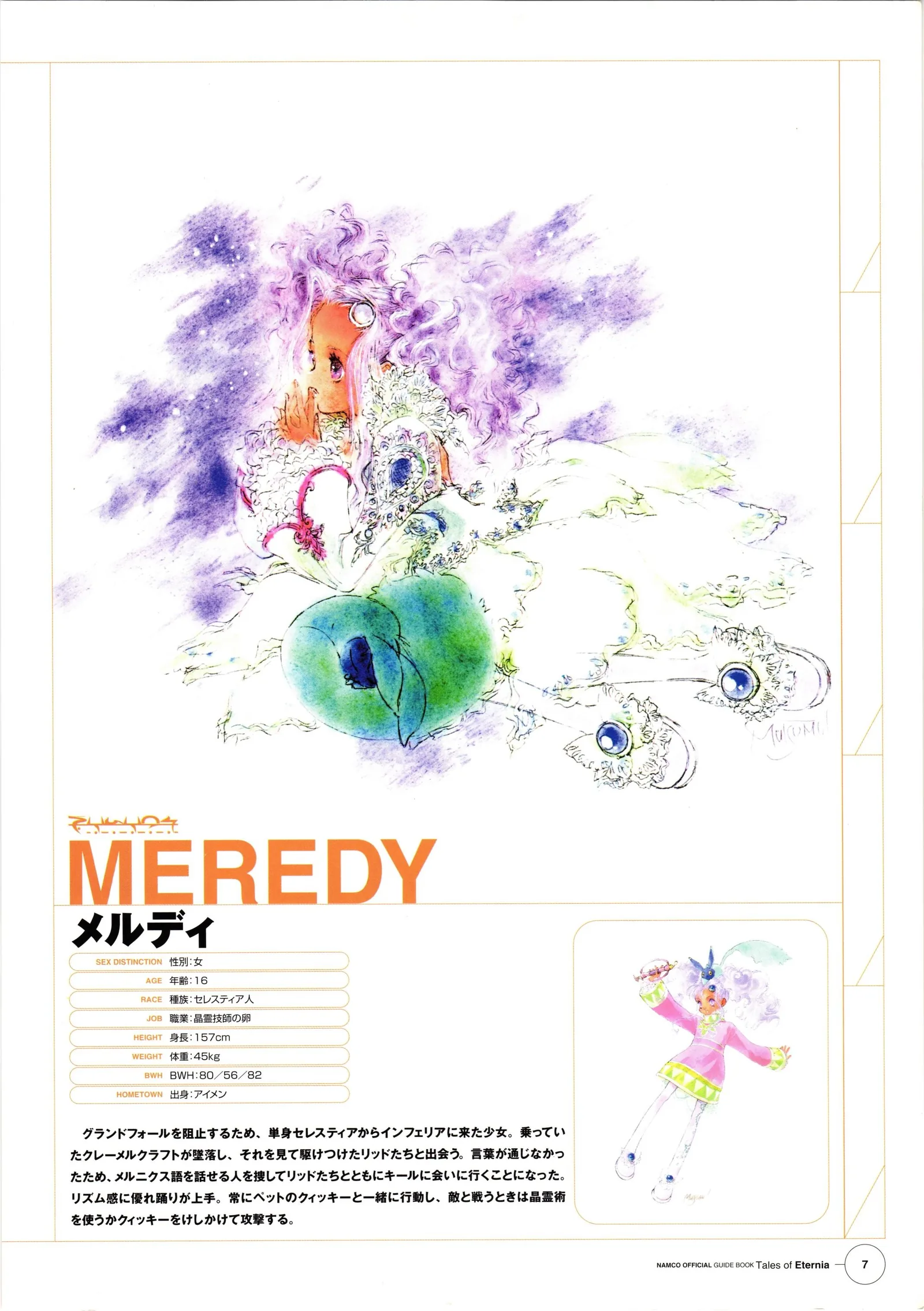
That page comes from the Namco Official GuideBook printed for the original 2000 Japanese release, which the Internet Archive has scanned in full; it introduced Meredy as a design and a personality first, and as the answer to the plot's central question much later.
The language barrier is real, not amnesia. Melnics is Celestia's common tongue and survives in Inferia only as an ancient language, which is why a whole village can hold a conversation with Meredy and come away with nothing. Progress on her comes from finding a translator, not from a revelation, and in the original release the barrier shows up in the menus too: Melnics writing becomes readable once Meredy is the character you control, or once Keele wears the Doctor Mintz title.
What the Grand Fall Actually Is
Bandai Namco Europe's feature article says Grand Fall; the Steam store description says Great Fall. Both describe the approach and eventual impact of Inferia and Celestia.
Official source: Tales of Eternia Remastered on Steam
It is not natural decay. In the original scenario the collision is pushed by Nereid, an entity from the immaterial world that predates this one, who wants to absorb every Craymel in Eternia and complete a forbidden power. That is also why the Greater Craymels help the party: the force killing the worlds is draining them, and the Fringe command that blends Craymels of different attributes into new techniques is how that system gets fought over. Craymel Cages decide which caster gets which Greater Craymel, and the Craymel Cage page covers the assignments.
- Fibril is Reid's power, described in the original material as the ability to take in Craymels of every attribute and blend them inside one body. It surfaces in play as the Aurora Arts used late in the game, and older sources treat Fibril and the Aurora Art as one thing.
- Nereid is not a new threat. Seyfert, the god credited with creating the material world, closed off space with the Seyfert Ring to end the Aurora War, producing the Eternia the game takes place in. Nereid was sealed underground at the end of that war by Regulus, a swordsman given power by one of Seyfert's messengers who sacrificed himself to do it. The hill where that happened is named after him, and it sits minutes from where the game starts.
Everything below covers the mid-game reveals and the ending, including who dies and who the final boss is. The post-credits section is the safe one to skip to.
The Story Act by Act
Inferia. Reid and Farah are on the village lookout in Rasheans when a light falls out of the sky nearby. What they find is Meredy: unconscious, in clothes nobody local recognises, speaking a language nobody local knows. They report her, the village chief Kamran orders her out of the village as an unknown quantity, and when a man attacks the chief's house in Meredy's language, the chief becomes certain the girl is the problem. All three leave Rasheans together. That attacker is Hyades, an aide to Celestia's overlord who was blackmailed into betraying his side, then experimented on for it, and who spends the rest of the game growing steadily less human.
The route across Inferia keeps returning to one night ten years earlier. Farah's father Norris went up Regulus Hill looking for the children, was possessed by a fragment of something unsealed there, turned into a monster and attacked Rasheans. Reid's father Bitz died along with half the village. That is the Rasheans tragedy, and it is not a side story.
Celestia. Meredy did not fall, she rode down, in a Craymel Craft built for the crossing, and the party eventually follows the same route the other way. On the far side they gain the Van Eltia, one of Celestia's seven great treasures, its self-appointed twelve-year-old captain Chat, and Max's resistance group Shikeska, who are fighting a government that has effectively stopped being run by a person.
That is where the plot's cruelest idea sits. Celestia's overlord, Baril, was an Inferian from Rasheans who made the crossing himself as a young researcher, married Shizel, and was murdered by the previous overlord for becoming too popular. Shizel awakened the Dark Aurora in that moment, killed the man responsible, and lost her mind to Nereid. From then on Celestia's government is a corpse propped up in a chair: she hides her husband's death, keeps his name as the sitting overlord to conceal her own existence, and pursues his old slogan about returning the world to a non-material state by forcing the Grand Fall. She also experiments on her own daughter, then discards her.
Meredy. She is Baril and Shizel's daughter, raised after her mother threw her away by Galenos, the engineer who built the craft she escaped in. The back half of the game assembles three answers: an Inferian boy with a power he cannot explain, a Celestian girl whose mother is the thing they are chasing, and a 2,000-year-old seal that has been leaking since before either was born.
How Tales of Eternia Ends
The final boss is Shizel, fought three times over the course of the game. The last of those fights is not only against her: Nereid takes her body for it, so the closing encounter is a two-stage affair, the woman first and the god behind her second. Reid's Fibril power, the true Aurora, then breaks Nereid's hold on her, and the party destroys Nereid. Freed and no longer possessed, Shizel does what Meredy was expected to do: she uses the Dark Aurora herself to stop the Grand Fall, and the effort kills her.
Both worlds survive and so does the party. The person they spend thirty hours fighting dies saving the thing she spent thirty hours trying to destroy, which makes this a resolution rather than a celebration.
After the Credits
| Post-credits content | Where it is | Remastered difference |
|---|---|---|
| Nereid's Labyrinth | High-difficulty dungeon, unlocked on reaching the interior of the castle the change list calls Balir Castle | Later playthroughs only in the original; here it opens in the first playthrough |
| Regulus | Deepest part of Nereid's Labyrinth, as a hidden boss | Nereid possesses the swordsman who sealed it in the first place |
| Glimmer Spire | Separate optional tower, six floors | Top-floor opponent is Valkyrie, and Reid fights that one alone |
| Second playthrough | Carryover from a cleared save | Titles were added to the carryover set in the day-one v.2.0.0 patch |
Official source: Tales of Eternia Remastered change list (Bandai Namco official site)
From here, the sidequest and missables page covers events with closing windows, the full walkthrough gives the act-by-act route, and the new game plus page has the carryover list.
Tales of Eternia Opening Song: GARNET CROW's "flying"
The original Japanese theme is "flying" by GARNET CROW, and that is the intro most searches for this are after. The 2001 English release did not use it, replacing it with an original orchestral piece, which is why returning players from North America remember the intro differently. This release puts the song back at the top of the game in its opening movie, and the animation under it is the part that was newly made.
Official source: Tales of Eternia Remastered: Opening Movie Released (Bandai Namco, Steam announcement)
FAQ
Does the Remastered release change the story or the ending? No. The change list is toggles, assists, subtitles, difficulty scheduling and interface work, and none of it rewrites the scenario, so the ending beats are the 2000 ones. What changed around the ending is the postgame schedule: Nereid's Labyrinth now opens in the first playthrough. Two non-story differences still affect how the plot plays, since this release follows the PSP port and is single-player only, and the destination icons plus a random-encounter switch let you follow the story without fighting your way along it.
Is the Tales of Eternia story connected to the other Tales games? No. It is a standalone story with its own world. Optional guest references to earlier titles exist, including an arena opponent from Tales of Phantasia, but nothing in the main plot depends on them.
Why do guides call the catastrophe both Grand Fall and Great Fall? Because the publisher writes it both ways. Bandai Namco Europe's feature article says Grand Fall, the Steam store description says Great Fall, and both mean the same collision.
Who is the final boss? Shizel, ruler of Celestia and Meredy's mother, possessed by Nereid. Nereid surfaces during the third fight. Reid's Fibril power breaks its control of her, and after Nereid is destroyed Shizel uses the Dark Aurora to stop the Grand Fall at the cost of her life.
Related Guides
- Tales of Eternia Original vs Remastered: What Changed - the presentation toggles, and why this release follows the PSP port.
- Tales of Eternia Remastered Walkthrough: Full Guide - the act-by-act route, if you want the story with directions attached.
- Tales of Eternia Sidequests and Missable Events - the events with closing windows, including what the hourglass icon warns about.
- Tales of Destiny II vs Tales of Destiny 2 Explained - the naming history behind the version many North American players remember.
- How Long to Beat Tales of Eternia Remastered? - how much of this plot you are signing up for, by play style.
- Tales of Eternia Remastered Beginner Guide and Tips - the systems to learn before the story starts asking you to win fights.
More Tales of Eternia Remastered Guides
What the Deluxe Edition and all seven Remastered DLC packs contain, what each costs, and the two restrictions Bandai Namco buried in the fine print.
How the combat levels work in Tales of Eternia Remastered: what is selectable from hour one, what unlocks on a second playthrough, and where to change it.
Reid's Eternal Sword, Farah's Omni Weapon and the six-piece legendary set behind Legendary Arsenal, plus armour, accessories and Gald priorities.
The Glimmer Spire floor by floor, the solo Valkyrie fight on the top level, and how the remaster opens Nereid's Labyrinth on a first playthrough.
Optional and EX bosses in Tales of Eternia explained and separated: Sekundes, Wraith Horus and Valkyrie, where each one lives and what each rewards.
HowLongToBeat has no remaster times yet; the 2000 original averages 33 hours for the story, 42 with sides and 73.5 hours for full completion.
Tales of Eternia Remastered holds a 76 Metascore: what reviewers praise, the 2D combat split, the Switch stick problem, and who should buy at $29.99.
Tales of Eternia leveling and Gald farming: Boost's experience and encounter dials, when grinding pays, and the mid-game buys worth saving for.